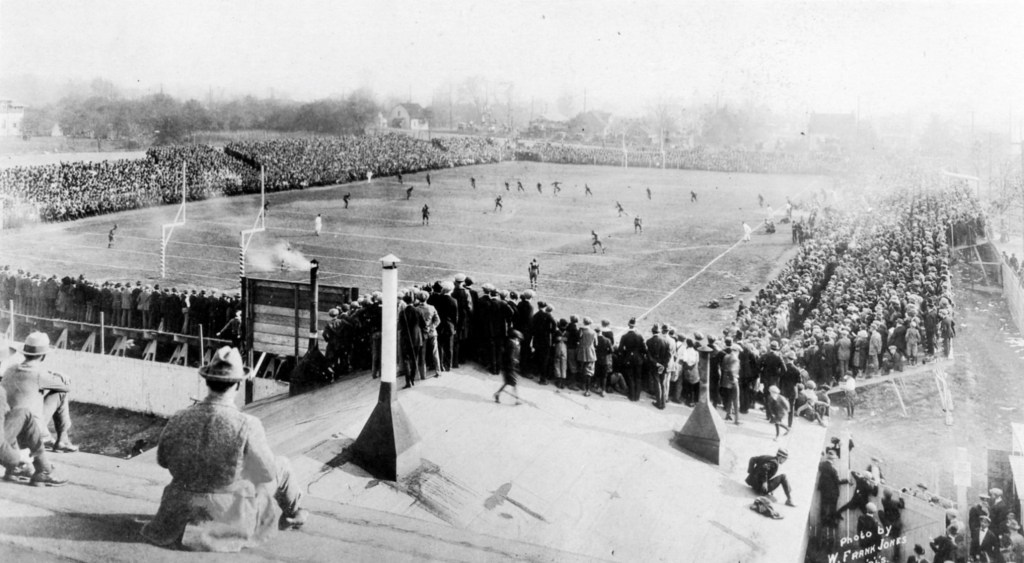
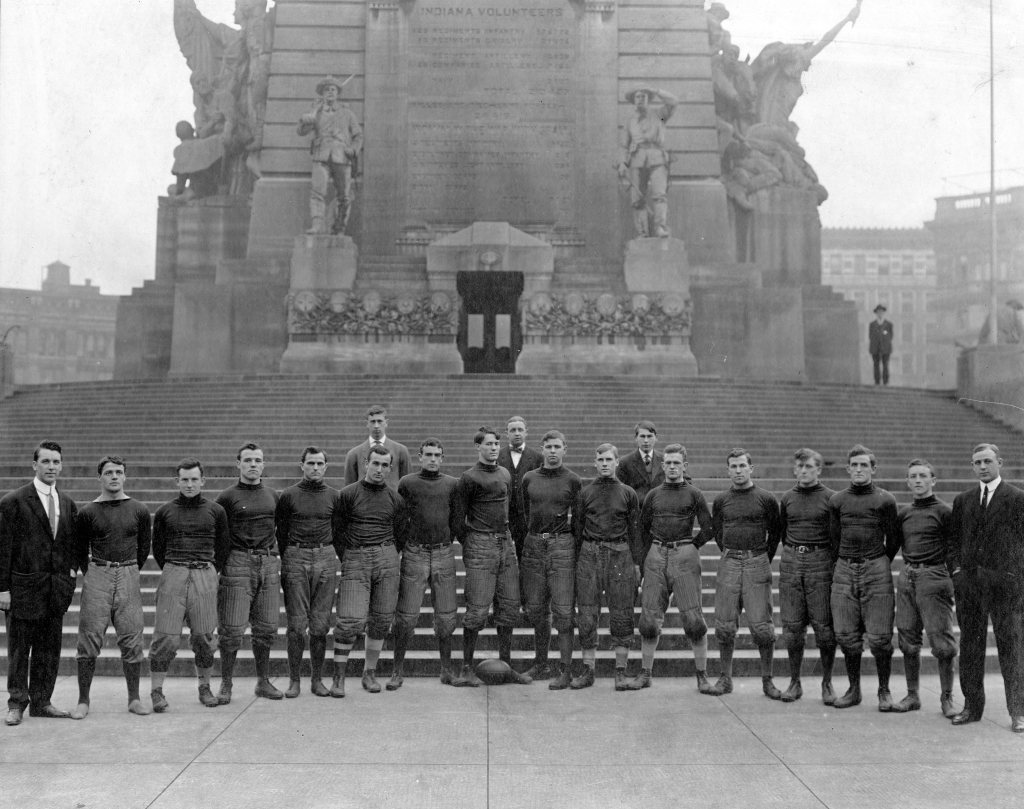
Credit: W. Frank Jones, Butler University Archives
With the national sports spotlight laser beamed on Bloomington, Indiana and IU’s rise to a national championship, it would likely surprise college football fans to learn Butler University’s eleven proved a worthy opponent in the early era of the sport.
An often quoted storyline from IU’s run is that coming into this season they held the humbling statistic of holding the worst record in college football history—715 losses to be exact. But in the very early days of college “rugby foot-ball”, long before the glitz and glam (and millions invested in some programs today), IU and Butler lined up on the same gridiron intent on establishing state dominance in this growing sports craze. As a result, Butler unknowingly contributed to the captivating storyline of IU’s “most losingest” program, adding 6 consecutive losses to IU’s record between 1891 and 1895. Or 5 of 6 if the IU record keeping is to be believed—more on that fascinating debate to come.
The Battle Begins
The first meeting between the two programs took place on October 24, 1891, at the State Fairgrounds in Indianapolis which a local paper declared “an excellent place for a foot-ball game”. It also noted the condition of the field as a “broad plat of perfectly level (but pretty hard) ground…”.
Before a crowd of nearly 700, Butler’s Christians (*1) defeated the “State University”, 52-6 as cheers of “Whoop la! Boom la! Butler! Rah! Rah! Rah!” rang out from spectators dressed in blue and white. That same year on November 11, the boys from Irvington (location of Butler’s campus then) took down the Bloomington boys 26-6 in what was declared an exhibition game, again at the State Fairgrounds before a smaller crowd of about 400. Despite IU’s the purported “beef” (size) as one sportswriter noted, the victories weren’t especially surprising considering Butler had won the two previous State Championships, knocking off Purdue in both contests.
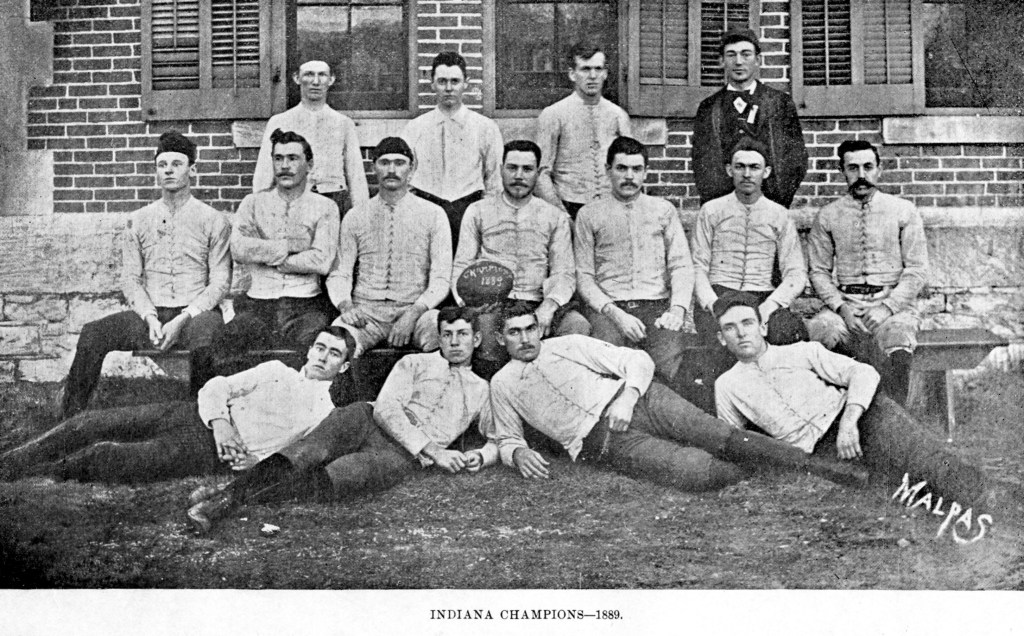
Credit: Butler University Archives
The next year’s match-up would prove to be a contentious one, and record keeping from both schools still reflects the dispute.
Gridiron Grudge
The season of 1892 held promise for both the Crimson and Blue and White teams. As football members of the Indiana Intercollegiate Athletic Association (IIAA) which included Purdue, Wabash, and Depauw, all teams saw action on October 15, 1892. In previewing the games, an Indianapolis newspaper noted that “the magnificent autumn weather has given better opportunity for training and practice than has been enjoyed for years…”. Of the Butler-IU game, victory was predicted in favor of the Bloomington contingent noting their “heavy men” and the “hard luck that Butler has had in her failure for so long a time to get a coach”. Played in Bloomington, the Indianapolis News reported that the grounds were “rather poor, elevated at the goals and not entirely cleared of stubble”. After the first four downs, IU gave up the ball to Butler who scored a touchdown on their first drive. After failing to “kick goal” the score stood at 4-0, Butler. IU’s next drive resulted in a touchdown and a kicked goal: IU 6, BU 4. In the second half, Butler again scored a touchdown, and again, failed to make the kicked goal—the paper noting the wet ball may have been an issue as rain had begun to fall. Score: BU 8, IU 6. The two teams battled evenly until Butler scored a safety resulting in BU’s 10 to IU’s 6.
The next series would define the game’s outcome, the protest that followed, and even IU’s record keeping which stands today.
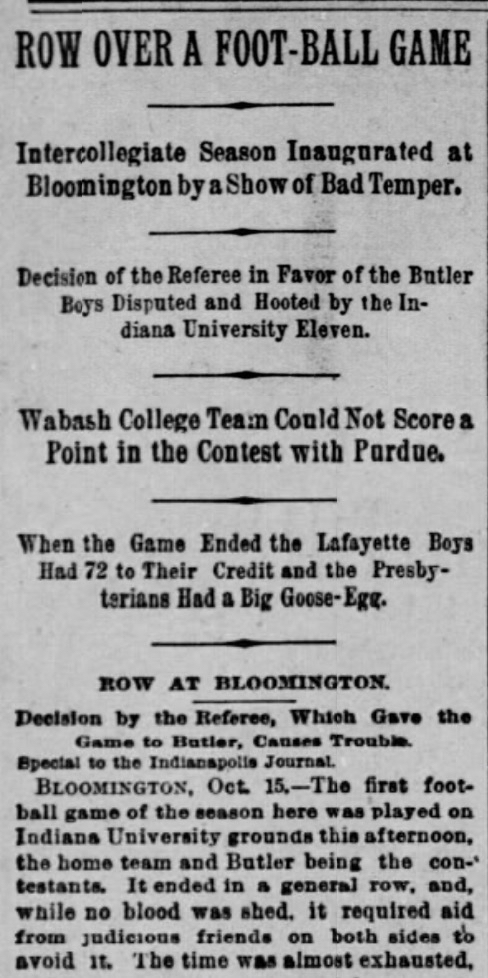
By use of the “center wedge”, IU gained ground deep into Butler territory. The decision was made to kick a field goal which would have raised the score to 11-10, IU. The paper reported that the ball “sailed high in the air above the height of the goal posts. The Bloomington spectators were eager for victory and to them it seemed that the ball took the proper direction.” The Butler elevens claimed the ball “plainly missed its mark by three feet.” Another Indianapolis paper reported that “each side waged a war of words at the referee, but he decided without hesitation that he was watching the ball himself and that it did not go over the goal”. At this ruling, the Bloomington team and sympathizers issued a “howl of protest” and play ended with the score BU 10, IU 6. Despite time on the clock, the Crimson refused to take the field again.
The Butler Collegian newspaper provided further insight into the chaotic atmosphere around the final play stating, “with a howl…the hoodlum element rushed upon the field and threatened to mob Mr. Waite (referee). On the way from the grounds the team was treated to a shower of stick and stones.”
IU followed up with a protest to the standing committee of the IIAA which was heard on October 29th. It was reported that during a long argument the “IU men insisted that the referee was incompetent and prejudiced”. The committee then decided that the appropriate action to take was to play the game over again. A literal do-over.
IU Waves the Crimson Flag
But the decisive game never took place. An Indianapolis News article on November 21 gives insight into why. Under the headline of “I.U. Will Not Play Butler Again” it continues:
“Early in the season, when only two of Butler’s experienced players were on the eleven, the first championship game of that college was played against Indiana University at Bloomington…when the referee decided against them (IU) the crowd swarmed the field and prevented play, and a protest afterward by I.U. was held valid on the ground that the game was not a complete one. In view of the strength Butler has developed since this game, I.U. decided to forfeit the second game that was to have been played on account of the protest.”
None of the remaining seven matchups between Butler and Indiana would have the same drama as the 1892 game possessed, although the Bulldogs would win 3 more games before the series ended in 1942.
Butler Continues It’s Winning Ways
The 1893 contest was played on October 28 at the Athletic Field on Ohio Street in Indianapolis, a park primarily used for baseball games. The weather was apparently chilly as it was reported the “small crowd shivered in looking on and occasionally ran to two large bonfires to restore circulation.” The Irvington boys won the battle 38-0, but the local paper noted “neither team was in good condition, the Indiana University fellows being tender and easily barked, though playing pluckily.”
On November 3, 1894, the two squads faced each other in Bloomington with Butler contending the referee was “severe” against them. Even if true, it was of no consequence as Butler won in a shutout, 58-0 (*2) with the game called early by consent of the two teams.
In the lead up to the November 16, 1895 tilt, a local paper noted that the State University had made strides over the past three years and that “the cultivation of the pigskin has received more attention at Bloomington”. Played once again at the Ohio Street ballfield, the Butler team had only won one game, and that against Knightstown—a club team made up of high school boys in nearby Henry County. The day was rainy and just a small crowd present to witness the game, although the paper said Butler “owes much to her enthusiastic rooters, who began their yells of encouragement before play was started.” Unlike previous meetings between the two teams, the paper added, “From start to finish it was a clean game and showed clearly that football can be made a manly sport and not a brutal slugging match. Not a single blow was struck and there were no boisterous quarrels over the official decisions”. Butler’s rooters were rewarded with a 34-2 victory.
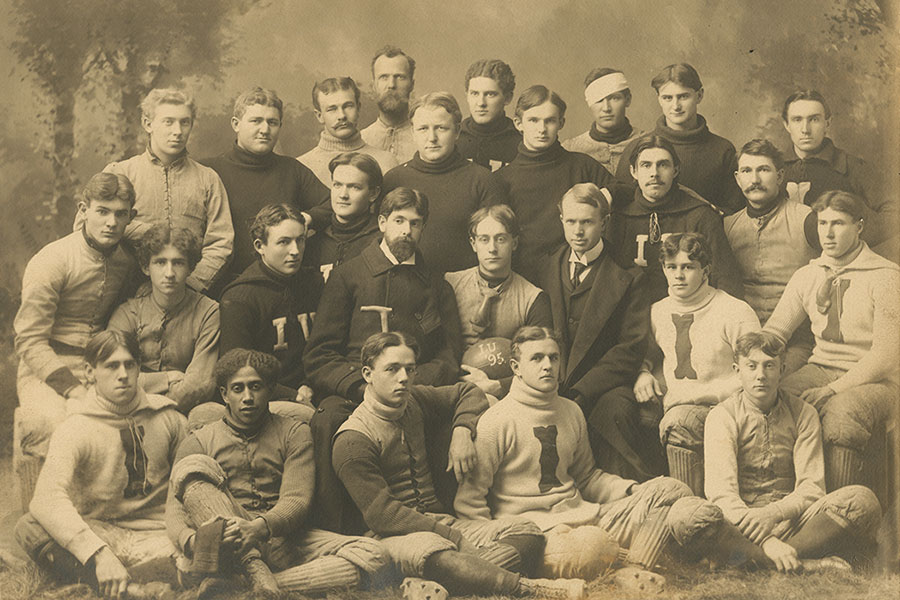
Finishing 4-3-1, the team recorded it’s first intercollegiate win after 7 seasons.
Credit: Indiana University Archives Photograph Collection
Football Fortunes Rise For IU
In 1896, IU’s string of defeats came to a close. Playing as Butler College under the banner of the University of Indianapolis (a short-lived alignment of Indiana Medical, Dental and Law with Butler serving as the liberal arts school) the game took place in Indianapolis at the Ohio Street ballpark. A preview of the game in the Indianapolis News mentions that “everyone in Bloomington is interested in the success of the team. The people here are beginning to realize that Indiana University now has an eleven worthy of attention…”. The Indianapolis Journal commented that the Indiana University team “came to town determined to have its revenge on the University of Indianapolis team for the long list of defeats that Butler had administered to I.U. in former years”. And revenge they got, downing the University of Indianapolis team (Butler), 22-6.
Nine years elapsed before the Butlerites met the State University in the Fall of 1905, and much had changed. They no longer played in the same conference as IU had joined the Western Conference (now Big 10) in 1899, and Butler dropped out of the IIAA in 1903 and competed as an independent. Butler now played at the newly dedicated Irwin Field on campus and was no longer a part of the University of Indianapolis (which had quietly disbanded) but kept the name, Butler College until the 1920s. Meeting in Bloomington on September 30, 1905, for a practice game, the teams found Jordan Field covered in several inches of mud. Rain continued to fall during the game as Butler provided little resistance to the Crimson who prevailed, 31-0.
The Game That Never Was
According to IU records, the teams met again four years later on October 30, 1909, with IU the victor, 33-0. While early record keeping can prove inaccurate by date or score, there are no public reports of any game or practices between the two programs that season. In fact, on that date Butler was playing DePauw in Indianapolis and IU was in St. Louis playing St. Louis University. Butler’s records show no match up with IU that year, nor do yearbooks for the two schools report the programs met. It appears likely the entry in the IU win column was erroneous.
IU’s Eyes Are On The Prize
The following season the two squads did meet up for what was termed a practice game on October 29th, 1910, at Jordan Field in Bloomington. IU’s focus was not on Butler but on their game with Illinois the following week. Newspaper headlines didn’t try to disguise that fact, stating: “Indiana Players Save Strength for Illinois” followed by “Contest With Butler Today of Little Importance”. Butler for its part expected a “good trouncing” based on the weight and strength of the Crimson. There was another reason the Irvingtonites held few hopes—six men had left the team earlier in the week after a tragedy the previous Saturday when a member of the Wabash team died after sustaining injuries in a game with St. Louis University. The six Butler players cited “parental objections” and turned in their uniforms, no doubt the size of the IU men causing concern. The Crimson won the game going away with 5 touchdowns scored in the first half and primarily substitutes playing the remainder of the game. Final score: IU 33, BU 0. The next week, Illinois defeated IU 3-0 at Bloomington.
Series Ends With Bulldogs On Top
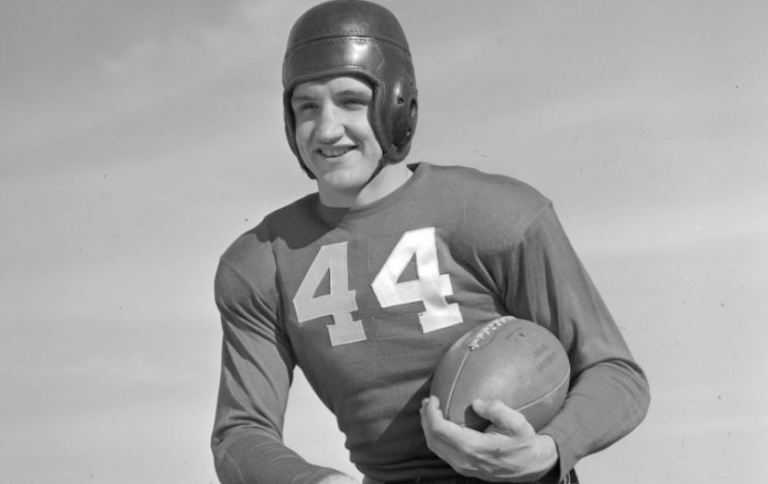
Credit: Indiana University Archives Photograph Collection
September 26, 1942, was the final contest between the two programs as they met at the old Memorial Stadium in Bloomington. The tilt was hyped as a “tune-up” for the Crimson who would begin Big 10 play the following week. Behind the spirited efforts of All American Billy Hillenbrand–who ran back Butler’s first punt 60 yards for touchdown–IU never looked back, racking up 53 points to BU’s 0. However, the Bulldogs weren’t alone that year in shut outs IU delivered–Purdue, Kansas State, Nebraska and Ft. Knox all chalked up goose eggs.
If keeping score, rather than a 6-5 record versus Butler in Indiana University’s favor as their record keeping indicates, digging deeper reveals Butler: 6 wins (1892 goes in the win column) to IU’s 4 wins (adjusted removal of the 1909 “win” that didn’t happen). Meaning Butler has had a positive impact on helping create the “worst team in football” storyline for IU (*3)—even contributing an additional loss not in IU’s accounting. Hoosier fans no doubt think an undefeated season and national championship more than makes up for this historical footnote, however!
- Butler University sports teams were often called the Christians in homage to their founding by members of the Christian Church (Disciples of Christ) in 1855. In 1919, “Bulldogs” was officially embraced by the school.
- While 58-0 is an impressive Butler win, the largest margin of victory was Butler walloping Hanover 121-0 in 1921.
- On November 8, 2025, Northwestern lost to USC racking up their 716th loss—which was assumed to surpass IU’s reported loss record of 715 (which was actually 716 including the 1892 loss to BU). In reality, Northwestern didn’t break IU’s record until the next week when they lost to Michigan for a total of 717 losses.
Grateful to Kyle Stearns, Butler University Archivist, and Joey Gruner from Butler Athletics for providing photos and recordkeeping information. Great teammates!
 Historic Hinkle Fieldhouse